High Quality Online Evidence-Based Learning For:
IBCLCs, CLCs, Lactation Professionals, Midwives, Nurses, Doulas, Childbirth Educators, Doctors, Students, & Other Perinatal Experts

"I knew breastfeeding was the BEST for every baby. I just didn't know exactly why. Now I do."
Deborah S Prather, CLC. LCCE, CD(DONA), PCD(DONA), USA
"Every health professional should know this information, to better improve maternal and infant health under your watch"
Debra Graham, IBCLC with Midwifery, Cambridge, UK

Watch The Course Preview

Evidence-Based
Updated for 2026

Clinically Applicable
Knowledge You Can Use In Your Practice TODAY

Approved For 17 Hours CPD
Which may be accepted as
17 L-CERPs by IBLCE
What You'll Learn:
✅The Connection Between Human Milk & The Microbiome
✅HMOs & Infant Immunity
✅Birth, Antibiotics & Gut Health
✅Expressed Milk, Donor Milk & ✅Infant Formula
✅Clinical Insights For Lactation Professionals

Breast Milk & The Infant Microbiome
Go At Your Own Pace With Instant Access
Covering:
👉Human Milk Science: HMOs, Microbes & Other Bioactives In Breast Milk,
👉Sealing Of The Infant Gut & Infant Immune System Training
👉The Protective Power Of Human Milk & How Milk Influences Brain Development
👉Knowledge YOU Can Use In Your Practice TODAY!
👉Includes Breastfeeding, Expressed Milk, Donor Milk & Infant Formula
✅ Updated for 2026
✅ Approved for 17 CPD HOURS / CE
Australian College of Midwives CPD Endorsed Activity
Approved by Midwifery Education Accreditation Council (MEAC)
✅ Which may be accepted as 17 L-CERPs by IBLCE
✅ Certiifcate of Completion
✅ 1 Year Unlimited Access
✅ Downloadable Resources
✅ Research Reference Lists
✅ 30 Day Money Back Guarantee
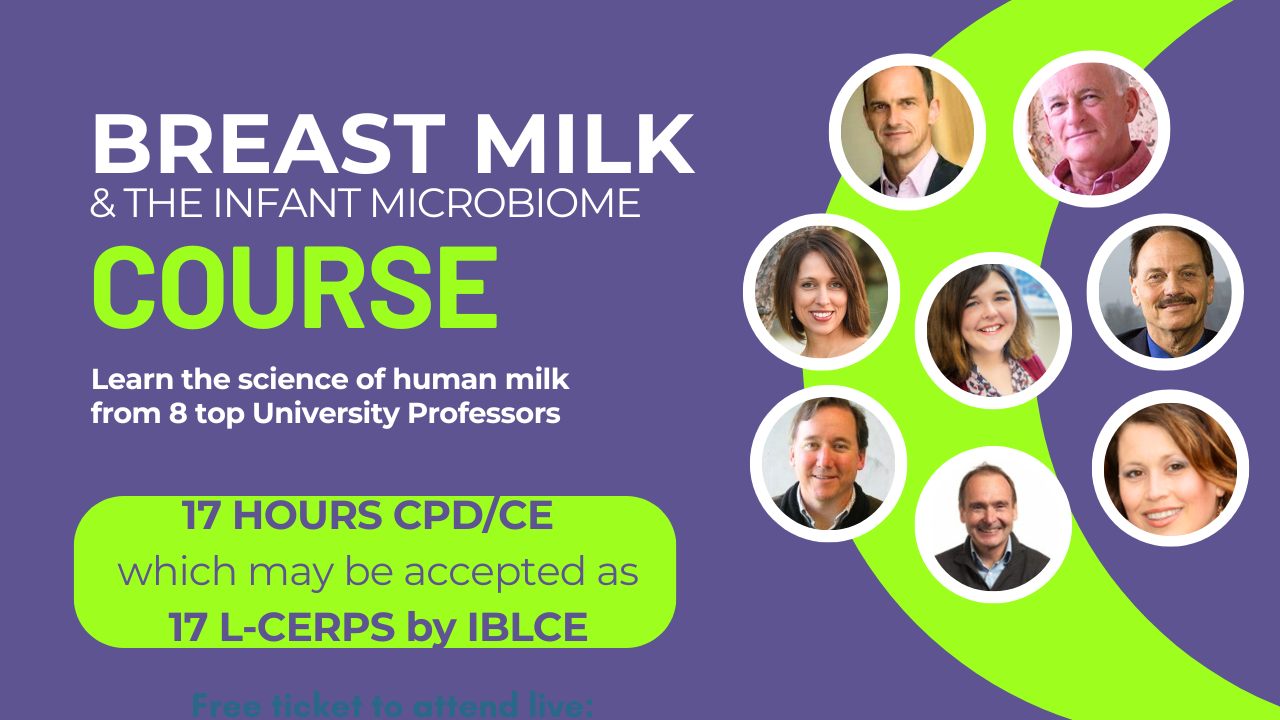
Learn DIRECT from 8 Top Lactation Scientists & 1 Neuroscientist

Lars Bode
Professor of Pediatrics, University of California, San Diego

Meghan Azad
Professor, Department of Pediatrics, University of Manitoba

Bruce German
Professor & Food Chemist, University of California, Davis

David Mills
Professor of Microbiology, University of California, Davis

Gregor Reid
Professor, Microbiology & Immunology, Western University

Rodney Dietert
Emeritus Professor, Immunotoxicology, Cornell University

Jennifer Smilowitz
Assistant Professor, University of California, Davis
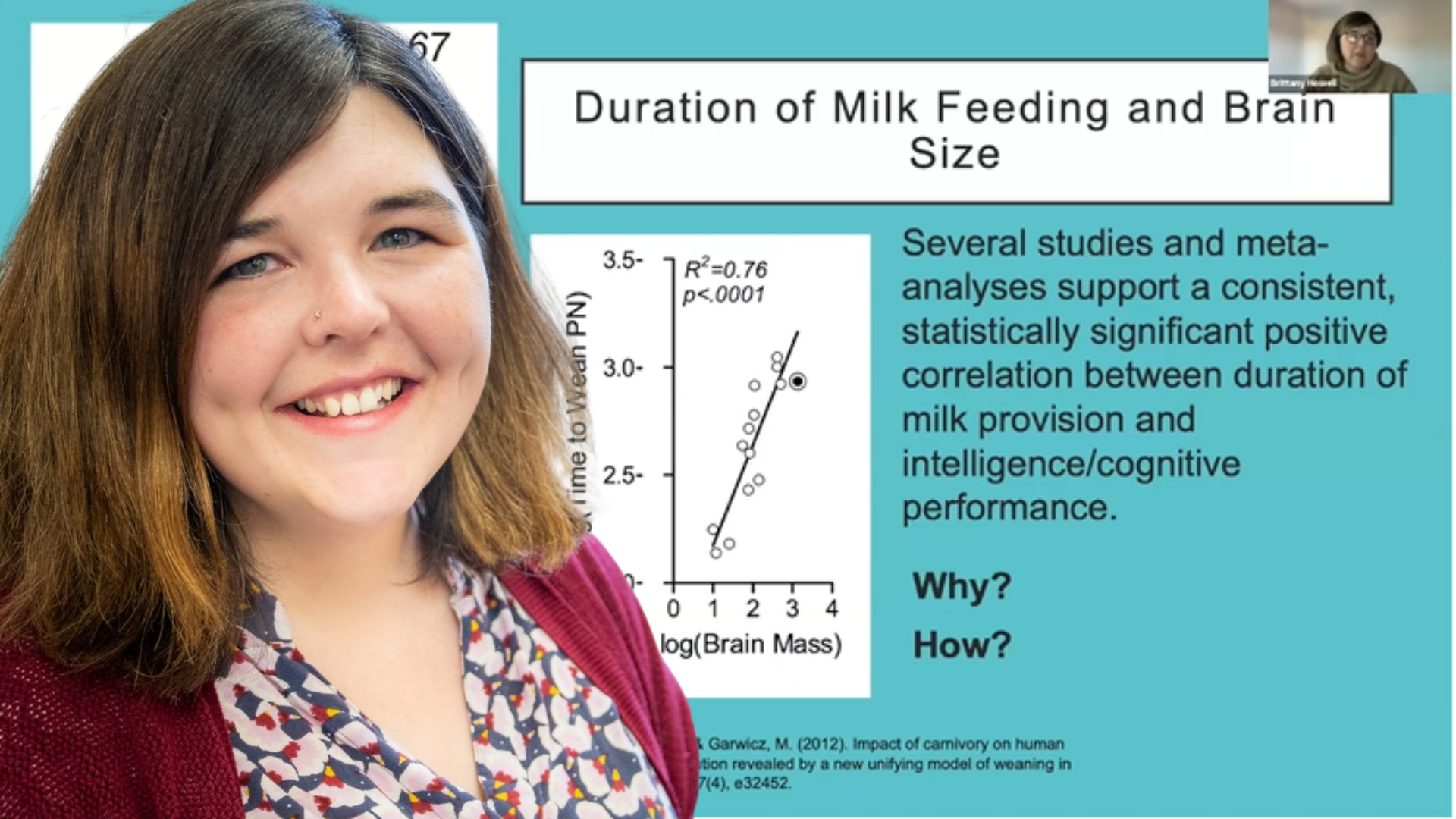
Brittany Howell
Assistant Professor, Neuroscience, Virginia Tech
COURSE FEATURES
100+ VISUAL-BASED PDFs
70+ SHORT VIDEOS FEATURING
8 TOP PROFESSORS & SCIENTISTS
PLUS GRADED TESTS,
DOWNLOADABLE HANDOUTS,
DISCUSSION FORUMS
& CERTIFICATE OF COMPLETION

Breast Milk & The Infant Microbiome
Course Curriculum
- 1. Session One - Learning Objectives
- 2. VIDEO: Meet the experts (3:50)
- 3. The evolution of lacation
- 4. VIDEO: The evolution of lactation (4:06)
- 5. The production of breast milk
- 6. VIDEO: How is breast milk produced by the mother? (2:37)
- 7. Lactogenesis
- 8. VIDEO: Why is human milk so special? (4:07)
- 9. Session One: Main components of breast milk
- 10. Session One - Scientfic references
- 11. Session One - Graded Test
- 12. Session One - Downloadable handouts
- 13. Session One: Discussion Forum and Reflection on Learning
- 1. Nutritive components of breast milk
- 2. VIDEO: What is in human breast milk (3:30)
- 3. Non-nutrititive components of breast milk
- 4. Further Learning Session One: Scientific references
- 5. Further Learning Session One: Graded Test
- 6. Further Learning Session One: Downloadable Handouts
- 7. Further Learning Session One: Discussion Forum (to reflect course content)
- 1. Session Two - Learning Objectives
- 2. Amounts and types of microbes in human milk
- 3. VIDEO: Microbes in human breast milk (3:36)
- 4. The uniqueness of microbes in breast milk
- 5. Session Two: Scientific references
- 6. Session Two: Graded Test
- 7. Session Two: Downloadable Handouts
- 8. Session Two: Discussion Forum and Reflection
- 1. Origins of microbes in human milk
- 2. VIDEO: Origin of microbes in human milk (0:59)
- 3.. Impact of antibiotics on human milk
- 4. Further Learning Session Two: Scientific references
- 5. Further Learning Session Two: Graded Test
- 6. Further Learning Session Two: Downloadable Handouts
- 7. Further Learning Session Two: Discussion Forum (reflect on course content)
- 1. Session Three -Learning objectives
- 2. Definition of human milk oligosaccharides
- 3. VIDEO: What are human milk oligosaccharides? (1:10)
- 4. Chemistry of human milk oligosaccharides
- 5. VIDEO: Chemistry of human milk oligosaccharides (2:15)
- 6. Types and quantities of HMOs in human breast milk
- 7. VIDEO: Types and quantities of HMOs in human milk (1:43)
- 8. Quantity of HMOs decrease over time
- 9. Session Three: Scientific references
- 10. Session Three - Graded Test
- 11. Session Three - Downloadable Handouts
- 12. Session Three: Discussion Forum and Reflection on Learning
- 1. Further Learning: More on chemisty of HMOs
- 2. VIDEO: Types of oligosaccharides in humans and other mammals (3:03)
- 3. Oligosaccharides in humans and other mammals
- 4. VIDEO: How are HMOs produced by the mother? (2:48)
- 5. Where and when are HMOs produced
- 6. Further Learning Session Three: Scientific references
- 7. Further Learning Session Three: Graded Test
- 8. Further Learning Session Three: Downloadable Handouts
- 9. Further Learning Session Three: Discussion Forum (to discuss and reflect on course content)
- 1. Session Four - Learning objectives
- 2. Diversity of HMOs produced by different mothers
- 3. VIDEO: Diversity of HMOs produced by different mothers (2:48)
- 4. Concentrations of HMOs
- 5. VIDEO: HMOs changing over period of lactation (2:21)
- 6. HMOs changing over period of lactation
- 7. VIDEO: HMOs in Colostrum (2:05)
- 8. Genetics and secretor status
- 9. VIDEO: How can you tell if someone is a secretor or non-secretor? (0:58)
- 10. Difference between secretors and non-secretors in human milk
- 11. Session Four: Science references
- 12. Session Four - Graded Test
- 13. Session Four - Downloadable Handouts
- 14. Session Four: Discussion Forum and Reflection on Learning
- 1. Further explanation about secretors and non-secretors
- 2. VIDEO: Difference between secretors and non-secretors? (1:34)
- 3. Variation in secretors vs non-secretors around the world
- 4. VIDEO: Advantages of being a secretor or a non-secretor (1:55)
- 5. Advantages of being a non-secretor
- 6. Further Learning Session Four: Scientific references
- 7. Further Learning Session Four: Graded Test
- 8. Further Learning Session Four: Downloadable Handouts
- 9. Further Learning Session Four: Discussion Forum (to discuss and reflect on course content)
- 1. Session Five - Learning objectives
- 2. Difference between probiotics and prebiotics
- 3. VIDEO: Difference between probiotics and prebiotics (1:59)
- 4. Possible prenatal exposures in the womb
- 5. VIDEO: Is a baby born ‘sterile’? (1:16)
- 6. Connection between microbes acquired from birth and HMOs
- 7. VIDEO: Connection between microbes from birth & HMOs in breast milk (1:42)
- 8. How does C-section affect the ‘seed and feed’ process?
- 9. Session Five: Science references
- 10. Session Five - Graded Test
- 11. Session Five - Downloadable Handouts
- 12. Session Five: Discussion Forum and Reflection on Learning
- 1. Why only certain microbes can digest HMOs
- 2. VIDEO: The types of microorganisms that can digest HMOs? (2:29)
- 3. What is special about bifidobacteria?
- 4. VIDEO: What is special about bifidobacteria? (4:38)
- 5. Impact of C-section antibiotics and formula feeding
- 6. VIDEO: Why are some types of microbes that consume HMOs ‘missing’? (3:25)
- 7. Further Learning Session Five: Scientific references
- 8. Further Learning Session Five: Graded Test
- 9. Further Learning Session Five: Downloadable Handouts
- 10. Further Learning Session Five: Discussion Forum (to discuss and reflect on course content)
- EXTRA VIDEO: HMOs are the perfect food for beneficial gut microbes (1:00)
- EXTRA VIDEO: Fermentation of HMOs and No. of poops per day (1:34)
- EXTRA VIDEO: Why is B. infantis so special? (1:05)
- EXTRA VIDEO: What should mothers know about B. Infantis? (1:42)
- EXTRA VIDEO: Why might B. Infantis be missing in some breastfed infants? (3:04)
- 1. Session Six - Learning objectives
- 2. Key immune components transferred to a baby in human milk
- 3. VIDEO: The importance of breast milk for the infant immune system (0:32)
- 4. The infant is born with an immature immune system
- 5. VIDEO: The gut microbiome & development of infant immune system (2:01)
- 6. The training of the infant immune system
- 7. VIDEO: The training of the infant immune system (2:38)
- 8. Role of HMOs in immune system training
- 9. VIDEO: Impact of HMOs on child health (1:51)
- 10. Summary of seed & feed process for optimal immune training
- 11. Session Six: Science references
- 12. Session Six - Graded Test
- 13. Session Six - Downloadable Handouts
- 14. Session Six: Discussion Forum and Reflection on Learning
- 1. Session Seven - Learning objectives
- 2. Fermentation of HMOs produces short chain fatty acids
- 3. VIDEO: Fermentation of HMOs produces short-chain fatty acids (2:18)
- 4 HMOs help improve the gut barrier
- 5. VIDEO: HMOs help improve the gut barrier (1:17)
- 6. Summary of benefits of short-chain fatty acids
- 7. VIDEO: Summary of benefits of short-chain fatty acids (SCFAs) (1:10)
- 8. The sealing of the infant gut
- 9. VIDEO: The sealing of the infant gut (1:33)
- 10. HMOs block crowd out attach to and trick pathogens
- 11. VIDEO: HMOs block, crowd out, attach to and trick pathogens (2:46)
- 12. HMOs and epithelial cells
- 13. Session Seven: Science references
- 14. Session Seven - Graded Test
- 15. Session Seven - Downloadable Handouts
- 16. Session Seven: Discussion Forum and Reflection on Learning
- 1. HMOS can help protect against certain diseases
- 2. VIDEO: Can HMOs help protect against asthma / GBS / NEC? (1:43)
- 3. Could HMOs directly affect other body systems
- 4. VIDEO: Can HMOs influence other body systems? (2:24)
- 5. HMOs and brain development
- 6. VIDEO: Breast milk and infant brain development (2:07)
- 7. Further Learning Session Seven: Scientific references
- 8. Further Learning Session Seven: Graded Test
- 9. Further Learning Session Seven: Downloadable Handouts
- 10. Further Learning Session Seven: Discussion Forum (to discuss and reflect on course content)
- EXTRA VIDEO: Multiple functions of HMOs (0:45)
- EXTRA VIDEO: HMOs and food allergies (1:08)
- EXTRA VIDEO: HMOs and antimicrobial resistance (0:50)
- EXTRA VIDEO: HMOs and HIV (1:36)
- EXTRA VIDEO: Breastfeeding and infant brain development (1:35)
- EXTRA VIDEO: Gut microbes and infant brain development (1:43)
- 1. Session Eight - Learning objectives
- 2. Expressed breast milk
- 3. VIDEO: Expressed breast milk (1:24)
- 4. Peer-to-peer sharing, wet-nursing and donor milk
- 5. VIDEO: Microbes in donor breast milk (1:33)
- 6. HMOs in donor breast milk
- 7. VIDEO: HMOs in donor breast milk (3:33)
- 8. Incubating mothers milk in donor breast milk
- 9. Session Eight: Science references
- 10. Session Eight - Graded Test
- 11. Session Eight - Downloadable Handouts
- 12. Session Eight: Discussion Forum and Reflection on Learning
- 1. The protective power of breast milk
- 2. SUGGESTED READING: Articles relating to the protective power of milk
- 3. Further Learning Session Eight: Scientific references
- 4. Further Learning Session Eight: Graded Test
- 5. Further Learning Session Eight: Downloadable Handouts
- 6. Further Learning Session Eight: Discussion Forum (to discuss and reflect on course content)
- EXTRA VIDEO:Are HMOs the the keys to infant health? (0:56)
- EXTRA VIDEO: What happens if a baby does not receive HMOs? (0:57)
- EXTRA VIDEO: Why do babies need breast milk? (1:07)
- EXTRA VIDEO: Connection between HMOs, microbes & infant health (0:37)
- EXTRA VIDEO: What are the implications of not breastfeeding? (0:46)
- 1. Session Nine- Learning objectives
- 2. Adding HMOs to infant formula
- 3. VIDEO: Why add HMOs to infant formula? (1:34)
- 4. Non-digestible carbohydrates and synthetic HMOs ?
- 5. VIDEO: How are HMOs synthetically produced (1:13)
- 6. HMOS added to infant formula and secretor status
- 7. VIDEO: HMOs added to infant formula and secretor status (1:00)
- 8. Results of clinical study of HMOs added to infant formula
- 9. VIDEO: How many types of HMOs are being added to infant formula? (2:18)
- 10.Are HMOs added to infant formula the same as HMOs in human milk?
- 11. VIDEO: Are HMOs added to infant formula exactly the same as HMOs in human milk? (2:49)
- 12. Impact on infant health of not receiving HMOs in human milk
- 13. VIDEO: How does adding HMOs to infant formula impact health? (2:49)
- 14. Session Nine: Science references
- 15. Session Nine - Graded Test
- 16. Session Nine - Downloadable Handouts
- 17. Session Nine: Discussion Forum and Reflection on Learning
- 1. Impact of formula-feeding on infant health
- 2. VIDEO: Long-term risks for infant health (1:21)
- 3. Could one bottle of infant formula impact infant health?
- 4. VIDEO: Could one bottle of infant formula impact infant health? (1:53)
- 5. Take-home messages
- 6. VIDEO: Your take-home message (2:08)
- 7. Further Learning Session Nine: Scientific references
- 8. Further Learning Session Nine: Graded Test
- 10. Further Learning Session Nine: Downloadable Handouts
- 8. Further Learning Session Nine: Discussion Forum (to reflect on course content)
- EXTRA VIDEO: Could infant formula ever match human breast milk? (0:44)
- EXTRA VIDEO: Long-term risks of formula feeding (1:00)
- EXTRA VIDEO: How does formula feeding impact the infant gut microbiome? (0:59)
- EXTRA VIDEO: Why are formula-fed infants more likely to be colonised by pathogens? (0:43)
- EXTRA VIDEO: Are HMOs in infant formula the same as HMOs in human milk? (0:58)
INCLUDES 2 EXCLUSIVE BONUSES
2 Evidence-Based Masterclass Presentations With Downloadable Transcripts

BONUS #1
Masterclass Presentation:
How Human Milk Shapes The Brain
Brittany Howell,
Assistant Professor of Neuroscience, Virginia Tech

BONUS #2
Masterclass Presentation:
Human Milk 101:
Composition of Human Milk vs Infant Formula
Jennifer Smilowitz,
Assistant Professor, University of California, Davis
Approved For 17 Hours CPD which may be accepted as 17 CERPs by IBLCE
17 HOURS CPD (Australian College of Midwives ACM)
17 HOURS / 1.7 CEUs (Midwifery Education Accreditation Council MEAC)
17 HOURS CPD can be used for revalidation by Nursing and Midwifery Council (NMC)
17 CE HOURS / 1.7 CEUs (MEAC) are applicable for Certified Professional Midwives recertifying through the North American Registry of Midwives (NARM)
17 CE HOURS by MEAC accepted as 17 Contact Hours by International Childbirth Education Association (ICEA)
17 CE HOURS by MEAC accepted as 17 Contact Hours by Childbirth and Postpartum Professional Association (CAPPA)
17 CE HOURS by MEAC accepted as 17 Contact Hours by LAMAZE International
17 CE HOURS by MEAC accepted as 17 Contact Hours by DONA International
✅17 CPD Hours which may be accepted as 17 L-CERPs by IBLCE
IMPORTANT CERP info:
According to the International Board of Lactation Consultant Examiners (IBLCE), Individual CERPs Guide for Recertificattion, Section IIIa, education that has been awarded educational credit by another board or organisation may be counted as CERPs.
Each CPD Hour credit from ACM (APPROVED) which may accepted as one CERP by IBLCE.
Total = 17 CPD HOURS (ACM) = which may be accepted as 17 L-CERPs by IBLCE.
CERP Recertification
IMPORTANT: If this course is purchased on or after January 1st 2026, according to the International Board of Lactation Consultant Examiners (IBLCE) Individual CERPs Guide For Recertification, Section IIIA, education that has been awarded educational credit by another board or organization may be counted as CERPs. This course has been awarded 17 HOURS CPD/CE continuing education credits from Australian College of Midwives (ACM) and MIdwifery Education Accreditation Council.
Each 17 Hours CPD credit may be accepted as 1 CERP by IBLCE, total which may be accepted 17 L-CERPs by IBLCE
Lactation specific education:
- Includes in-person presentations, online education, distance learning and independent study modules.
- Education may be from an IBLCE verified Continuing Education Recognition Points (CERP) Provider, but it is not required to be. If you attend a session that has been awarded CERPs by IBLCE: For your lactation education requirement, only the hours verified as L-CERPs will be accepted.
- For the two (2) hours of WHO Code education requirement only, the hours could have been assigned L- or E-CERPs.
- For the five (5) hours of education focused on communication skills only, the hours could have been assigned L- or R-CERPs.
- Education is to be on topics that are specific to lactation and breastfeeding, examples of which can be found on the IBCLC Detailed Content Outline.
- One education hour for 60 minutes of education.
Breast Milk and the Microbiome
17 CPD Hours – approved BY ACM
Which may be accepted as 17 CERPs by IBLCE in the following categories as outlined by IBCLC-Commission Detailed Content Outline:
International Board of Lactation Consultant Examiners.
Detailed Content Outline
International Board of Lactation Consultant Examiners. Detailed Content Outline
I. Development and Nutrition
A. Infant
2. Food intolerances/allergies
· Session 6: Infant Immune Training
· Session 6: Further Learning: Infant Immune Training
· 2 HOURS
3. Infant anatomy and anatomical/oral challenges
· Session 5: HMOs and Microbes In The Infant Gut
· Session 5: Further Learning: HMOs and Microbes In The Infant Gut
· 2 HOURS
4. WHO guidelines for introducing complementary foods
· Session 9: HMOs and Infant Formula
· Session 9: Further Learning: HMOs and Infant Formula
· 1 HOUR
6. Milk banking – formal and informal
· Session 8: Expressed Milk and Donor Milk
· 1 HOUR
7. Normal infant behaviours
· Session 6: How HMOs Affect Infant Body Systems
· Session 6: Further Learning: How HMOs Affect Infant Body Systems
· 2 HOURS
11. Term development and growth
· Session 8: Further Learning: The Protective Power of Breast Milk
· 1 HOUR
B. Maternal
3. Composition of human milk
· Session 1: Introduction to human milk
· Session 1: Further Learning: What is in human milk?
· Session 2: Microbes in Human Milk
· Session 2: Further Learning: Microbes in Human Milk
· Session 3: HMOs in Human Milk
· Session 3: Further Learning: HMOs in Human Milk
· 6 HOURS
4. Maternal anatomical challenges
· Session 4: Variations of HMOs in Different Mothers
· Session 4: Further Learning: Secretors versus Non-secretors
· 2 HOURS
Total 17 HOURS = which may be accepted as 17 L-CERPs by IBLCE
Over 1,000 people have taken this course.
What do they think?
"Wow, what a fantastic course! I have learned so much about the perfectly evolved microbiological interplay between a mother's milk, her baby's microbiome and the affect this has on lifelong health.
The knowledge gained has strengthened my feelings of responsibility and determination to provide families with the support, protection and information they need to facilitate the optimal "seeding and feeding" of their baby's microbiome.
Throughout the course, as a breastfeeding mum myself, I felt in awe of and proud of how my body works with my babies' bodies to actively protect their health.
I strongly recommend this course to anyone working with mothers and babies"
- Esther Gurau BSc(hons), RM, IBCLC, Mother.
"Wow. So much information that is so relevant. The experts were so compelling. Such an interesting subject and confirms the notion that breastmilk is complicated and important to the survival of our species. I applaud you all."
Karen Hartling


More Feedback From Previous Attendees
I loved this course! I've taken your other mini courses before, and I've loved them all! I definitely have an affection towards microbes now, and I'm always sharing my findings with others! Definitely would recommend!
Ronee Welch, CLC, sleep consultant, parenting coach, infant massage educator, nutrition coach, health/life coach, Pennsylvania, USA
Every health professional should know this information....it will guide and empower you in your work to better improve maternal and infant health under your watch
Debra Graham, IBCLC with Midwifery, Cambridge, UK
This is a deep dive into a significant element of human milk, HMOs. I didn't understand the importance and the mechanism of them until now.
Suzanne W Crable, Lactation Consultant, Cincinnati, Ohio, USA
Well presented course that expanded my knowledge and ensured I have more evidenced based information to support the families I work with .Thank You
Robyn Watson, CHN Lactation consultant, QLD Australia
This is a significant course that provides key insights into the desirability of breastfeeding. Along with the health factors, the breeding/feeding for healthy microbiota, gut evolution and depth of important organ development - this is a dynamic course for all!
Roxane Thompson, Birth Doula, Greater Bay Area SF/Peninsula California
Breast Milk and the Infant Microbiome is a a well organized and informative presentation on the properties if human milk specifically HMOs. I have been a lactation consultant and maternal child nurse for many years, this course expanded my knowledge base and will improve my practice and staff education repertoire. I would recommend this course to lactation consultants and health care providers supporting breastfeeding families.
Marcia Tessier, RN Lactation Consultant, Massachusetts, USA
I knew breastfeeding was the BEST for every baby. I just didn't know exactly why. Now I do. I know about the three ways to learn. By reading and then watching a video it combined auditory and visual learning. Now to figure out what information to present to clients as a childbirth educator, a doula, and CLC.
Deborah S Prather, CLC. LCCE (Lamaze certified childbirth educator), a CD(DONA) and a PCD(DONA) - that's a DONA certified birth and postpartum doula, Fredericksburg, Virginia
This course about the micobiome of the infant's gut/intestine is very worthwhile. I goes into detail about the oligosaccharides and immunity system which is mentioned. This course breaks them down and boost your confidence. I have been hearing since 2008 that even 1(one) bottle can disrupt the infant's microbiota and this course confirms that. I have learnt a great deal of knowledge, thanks to the researchers and organizers. When you see the word MICROBIOME and MICROBIOTA, they seem boring but this course brings them alive, I am glad I signed up for it. It is well worth it. I would have regretted it if I did not do it.
Paultina Anderson, I am a retired nurse and midwife and an IBCLC, Trinidad and Tobago West Indies
FAQ
Q. How long do I get access?
A. One year unlimited access. In that time, you can take the course as many time as you like!
Q. Do I get a downloaded certificate of completion when I finish the course?
A. Yes. A form-fillable PDF is available immediately you finish the course.
Q. Who funded this course?
A. This course has been created and independently funded by Toni Harman and Alex Wakeford, the founders of MICROBIOME COURSES. #Toni and Alex are the filmmakers behind the award-winning documentary MICROBIRTH. Toni and Alex, and their company Alto Films Ltd, are completely independent. We have no affiliations with, and receive no income from, any other organisation or company.
Q. What CPD/CE do I receive?
A. 17 HOURS CPD (ACM/MEAC)
Which may be accepted as 17 L-CERPs by IBLCE.
More information on Continuing Education / Continuing Professional Development credits
17 CPD HOURS - Approved by Australian College of Midwives (ACM)
This course can be used as 17 HOURS CPD for revalidation by the Nursing and Midwifery Council (NMC) in the UK
17 HOURS / 1.7 CEUs have been approved by the Midwifery Educational Accreditation Council (MEAC) Program No #M2526-94-0703DE
These Midwifery CEUs are applicable for Certified Professional Midwives recertifying through the North American Registry of Midwives (NARM) and can also be used for recertification and general career development by midwives and other healthcare providers.
1.7 CEUs (MEAC) Program No #M2526-94-0703DE accepted as 17 HOURS of continuing education (17 CONTACT HOURS) by ICEA, CAPPA, LAMAZE International and DONA International.
Q. What about CERPs?
A. Important note: Due to a rule change for IBLCE Short Term Providers that came into place on 1st January 2026, this course may be accepted for Continuing Education Recognition Points (CERPs) by IBLCE.
If this course is purchased on or after January 1st 2026, according to the International Board of Lactation Consultant Examiners (IBLCE) Individual CERPs Guide For Recertification, Section IIIA, education that has been awarded educational credit by another board or organization may be counted as CERPs. This course has been awarded 17 HOURS CPD/CE continuing education credits from Australian College of MIdwives (ACM) and MIdwifery Education Accreditation Council. Each 17 Hours CPD credit which may be accepted as 1 CERP by IBLCE, total which may be accepted 17 L-CERPs by IBLCE.
17 CPD Hours – approved BY ACM
Which may be accepted as 17 CERPs by IBLCE in the following categories as outlined by IBCLC-Commission Detailed Content Outline:
International Board of Lactation Consultant Examiners. Detailed Content Outline
I. Development and Nutrition
A. Infant
2. Food intolerances/allergies
· Session 6: Infant Immune Training
· Session 6: Further Learning: Infant Immune Training
· 2 HOURS
3. Infant anatomy and anatomical/oral challenges
· Session 5: HMOs and Microbes In The Infant Gut
· Session 5: Further Learning: HMOs and Microbes In The Infant Gut
· 2 HOURS
4. WHO guidelines for introducing complementary foods
· Session 9: HMOs and Infant Formula
· Session 9: Further Learning: HMOs and Infant Formula
· 1 HOUR
6. Milk banking – formal and informal
· Session 8: Expressed Milk and Donor Milk
· 1 HOUR
7. Normal infant behaviours
· Session 6: How HMOs Affect Infant Body Systems
· Session 6: Further Learning: How HMOs Affect Infant Body Systems
· 2 HOURS
11. Term development and growth
· Session 8: Further Learning: The Protective Power of Breast Milk
· 1 HOUR
B. Maternal
3. Composition of human milk
· Session 1: Introduction to human milk
· Session 1: Further Learning: What is in human milk?
· Session 2: Microbes in Human Milk
· Session 2: Further Learning: Microbes in Human Milk
· Session 3: HMOs in Human Milk
· Session 3: Further Learning: HMOs in Human Milk
· 6 HOURS
4. Maternal anatomical challenges
· Session 4: Variations of HMOs in Different Mothers
· Session 4: Further Learning: Secretors versus Non-secretors
· 2 HOURS
Total 17 HOURS = which may be accepted as 17 L-CERPs by IBLCE
Q. Re CERPs, what if I have purchased the course before?
A. This CERPs are ONLY available if you purchase the course AFTER 1st January 2026. If you have purchased the course before 1st January 2026, then the CPD credits will not be accepted by IBLCE as CERPs.
Q. Has the course been updated recently?
A. Yes, we have updated the course content in the past 6 months (Dec 2025/Jan 2026), so that the information is evidence-based and accurate.
Q. Can I get a refund if I don't like it?
A. We offer a 30 day money back guarantee. If you buy the course and don't like it, let us know and we'll give you a full refund. Contact us using this form: https://microbirth.com/contact-us/
Q. What if I have another question?
A. Contact us using this form: https://microbirth.com/contact-us/